
Ready to
Get Started?
Request an Appointment
Get Started?

Being afraid of dentists is normal, as 36% of Americans now fear getting any dental work. Still, you shouldn’t let this anxiety keep you from crucial oral care; doing so would damage your teeth and gums. A better approach is to get help from your sedation dentist in Glastonbury! With Glastonbury Dental Care’s sedatives, you can have a smoother and less stressful treatment. Learn more about how them by reading below or by booking a visit!
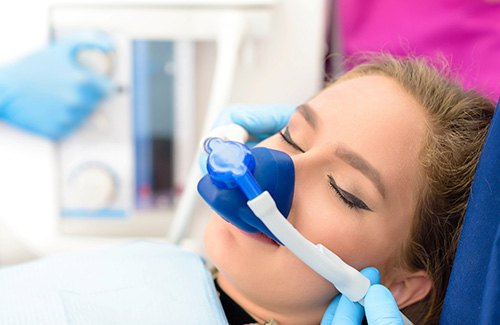
Do you need extensive dental care, like a root canal? Maybe you’re overdue for your six-month checkup, but the dental-related anxiety that you experience makes scheduling a visit too overwhelming. Whatever the case may be, don’t hesitate to talk to our team about dental nitrous oxide in Glastonbury! This calming solution can alleviate nerves, stress, and fear, allowing you to relax comfortably while we provide the dental care that you need.

Nitrous oxide has been helping children and adults alike have the anxiety-free experience that they deserve for decades now. In fact, it’s so popular that you’ve probably already heard of it: laughing gas. It is particularly helpful for patients who:
So, if one or more of these apply to you, let our team at Glastonbury Dental Care know that you’re interested in adding nitrous oxide sedation to your treatment plan. From there, we can review your dental history, needs, and goals to determine if you’re a good candidate.
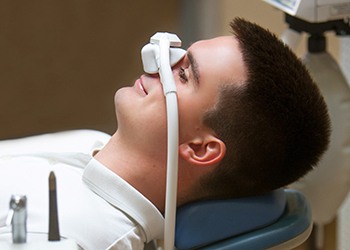
Nitrous oxide is administered through a nose mask. Once you settle into the treatment chair, we will position it in place and ask you to breathe in and out through your nose. Within a matter of minutes, you’ll feel the effects set in, which many patients describe as calm, light, and mildly euphoric.
Throughout your appointment, we can adjust the flow of nitrous oxide as needed to ensure you stay calm and comfortable. Since you’ll be awake, you can also easily ask questions and respond to verbal cues. Once we’re done providing the preventive, restorative, or cosmetic dental care that you need, we will let you know and remove the nose mask.

One of the many benefits of nitrous oxide is that the effects are short-lived and quickly fade after treatment. As a result, you can drive yourself home from our office! Just make sure that you follow any aftercare instructions pertaining to the treatment that we provided. For example, if we placed a dental filling, we may ask you not to chew on that side of your mouth and to rinse with warm saltwater periodically.

Stronger than nitrous oxide is oral conscious sedation in Glastonbury. This easy-to-use solution requires patients to take a pill that will create a deep state of relaxation once they are in the treatment chair. Instead of wearing a nasal mask throughout treatment, oral conscious sedation is taken beforehand, allowing a person to remain at ease during their appointment, remaining unbothered by what our team is doing to enhance and improve their smile.
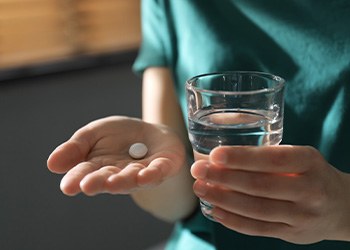
Relaxation, comfort, and a calming effect are what you can expect when choosing to take oral sedation in Glastonbury. As a moderate solution designed to help patients avoid anxiety when visiting the dentist’s office, it “takes the edge off” when more complex care is required.
Depending on the dentist, the medication that is used might be Valium, Halcion, or Ativan. The type of pill will be determined after a scheduled consultation.

Unlike nitrous oxide, oral conscious sedation takes the form of a pill. This prescribed medicine is taken before the dental visit and “kicks in” once treatment starts. At that time, the patient will feel deeply relaxed (and even a bit tired) while the dentist and their team act. Such effects make the oral conscious method suited for long procedures and patients with moderate-to-high anxiety.
The oral conscious sedative is longer-lasting than nitrous oxide, so it takes time to exit a person’s system. That means a friend or family member should be responsible for driving the patient to and from their appointment.

Good candidates for oral sedation usually exhibit one or more of the following:
Without a doubt, sedation dentistry is quite safe. Its methods and medicines won’t harm your teeth, gums, or any other part of your body.
Nitrous oxide sedation is well-known as one of the safest types. It just applies “laughing gas” through a nose mask, so its effects are quite mild and harmless. The used gas will just make you feel calm and slightly euphoric; there won’t be any bodily damage.
Even for other types of sedation, dentists take proper precautions. They’ll review your health history beforehand to ensure medications won’t cause adverse reactions. Plus, they’ll monitor your vitals during treatment to keep you safe.
You likely won’t remember much of your sedation afterwards. Still, please rest assured; any impact on your memory will be temporary and fade quickly.
Many sedatives impact short-term memory, making it harder to form memories while in use. That means you may not recall a lot of your treatment after the fact. Different sedatives have different effects, though; some will leave you more forgetful than others. Mild kinds like nitrous oxide and orally-ingested pills don’t affect memory too much.
Really, any (temporary) memory loss you experience won’t be bad. It’ll make your care easier by helping you forget your anxiety, as well as any other “bad” dental experiences you’ve had.
Though it has the nickname “sleep dentistry,” sedation dentistry shouldn’t make you fall asleep. Any sedative you receive (minus anesthesia) will leave you awake and alert.
At most, sedation might make your memories a bit fuzzy. This effect can cause some patients to feel as though they’re sleeping, even when they aren’t. There’s also a slight chance of grogginess, especially with oral conscious sedation. That said, you needn’t worry; we’ll gently nudge you awake if necessary.
Any side effects from sedation dentistry are short-lived; they quickly fade. Even so, you’d do well to note them ahead of time.
Depending on the sedative you get, you may experience side effects like:
How long these effects last varies by sedative. If you receive nitrous oxide, they’ll stop shortly after you stop breathing the gas. Patients who get oral conscious sedation, meanwhile, may experience the side effects for a few hours.