
Ready to
Get Started?
Request an Appointment
Get Started?

If you ask any dentist whether tooth extractions are something they want to perform, they’ll likely tell you that they are only recommended as a last resort. Why? Because there are too many other restorative options that can be used to treat a severely decayed or damaged tooth. However, when all these other solutions prove unsuccessful, the only way to safeguard a person’s oral health may be an extraction. To learn more about this emergency dental treatment, including when we recommend it, get in touch with us or read on.

At Glastonbury Dental Care, we only recommend tooth extractions when they are absolutely necessary. A few examples include:
If one or more of the above apply, you can have peace of mind knowing that we take a careful approach to tooth removal, ensuring the safety and comfort of each patient so that before, during, and after treatment, they have the best chance of a successful recovery.
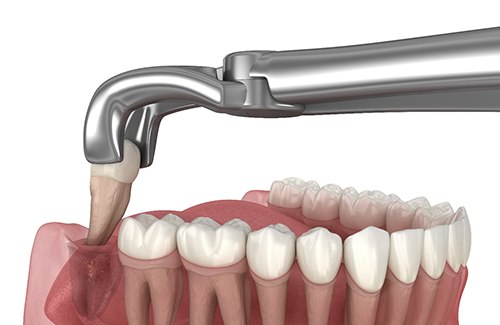
If the tooth in question has broken through the gumline, then your dentist in Glastonbury will intervene with a simple extraction. The first step is gripping the tooth and slowly rocking it back and forth until it’s ready to be removed. Then, they will pull it from the socket and tend to the extraction site. Since your mouth will be numb, you won’t feel any discomfort or pain during this process.

Following your tooth extraction in Glastonbury, it’s important to:
After a few days, any discomfort, sensitivity, or soreness you’re experiencing should subside. Around the one-week mark, you should be able to resume your usual diet as well. As always, if you have any questions during the recovery process, you shouldn’t hesitate to get in touch with us!
Tooth extractions are generally affordable for most patients. During your consultation, we will consider all relevant factors before we provide an estimate that is tailored to your unique situation. We will also be happy to share information about payment options. We welcome dental insurance and accept financing through CareCredit. Remember that tooth extractions can be a vital step toward pain-free dental function and improved oral health!

Some factors that may influence the cost of your tooth extractions in our Glastonbury office include:

In most cases, yes, dental insurance does cover tooth extractions. Simple extractions are often classified as a basic service, so they might be up to 80% covered. More complex extractions may be around 50% covered. With the help of their benefits, many patients are able to lower their out-of-pocket obligation by hundreds of dollars. Our team welcomes insurance, and we will be happy to help you figure out how your benefits apply. We are even in-network with several popular plans.

Outside of insurance, another helpful provision is financing through CareCredit. This third-party company specializes in providing low-interest payment plans for medical and dental services. The application process is fast, and most people are readily approved for a monthly installment amount that fits into their budget.
We can also help you afford tooth replacement after your extractions. Ask us about our special pricing for dental implants!
Are you interested in learning more about tooth extractions and their cost? Contact us today so we can answer all your questions!
You’re not alone if you’re avoiding scheduling your procedure because you’re worried it will inevitably be a long, agonizing process. Plenty of people feel anxious when it comes to having one or more teeth pulled because they’re afraid it could hurt.
But our compassionate providers understand that you might be nervous, and will do everything they can to help you feel calm and comfortable. For instance, we will numb your mouth before starting the procedure, so you might feel some pressure while we work, but not pain. We also offer nitrous oxide (laughing gas) and oral conscious sedation (as a pill), which can help you get through your appointment successfully.
If you’re hoping to avoid an extraction, you might wonder whether other services, like a root canal or placing a dental crown, can be used to treat your damaged tooth instead. However, if our team has recommended this procedure, we’ve probably already ruled out other possibilities.
In many cases, this service is offered as a last resort when teeth are too overcrowded, decayed, or damaged for other options to address the root cause. If you’re wondering why we’ve suggested it, please feel free to ask! We’re happy to walk you through the details so that you feel confident moving forward.
Some patients are curious if it’s considered safe or acceptable to leave the space empty after their troublesome tooth is removed, especially if the gap is located somewhere in their grin that others don’t usually see, like the back of their mouths.
But there are additional risks of tooth loss you might not have considered. For instance, without a root in place to activate your jawbone each time you bite down, it eventually thins and can become too frail to support your remaining teeth. Not only that, but those left behind are prone to shifting out of alignment to fill empty spaces, which can harm your teeth or bite alignment. As a result, we typically recommend that patients replace their extracted teeth sooner rather than later.
We understand that you might have questions regarding the best ways to rebuild your smile after your extraction, and we are happy to provide professional recommendations based on your unique circumstances. Our practice offers several potential treatment options, including: